
Columbus Mayor Ginther and City Council are obsessed with building density through Columbus’s most popular corridors and passed “Zone In” to make this happen. They are also quietly pushing for sprawl and greater density – and a data center – within the Big Darby Creek Watershed.
They won’t be passing another law, however. Instead, they will tweak the Big Darby Accord, the non-legally binding land agreement made in 2006 amongst 10 jurisdictions such as Columbus, Hilliard, Prairie Township and others. The Accord covers the western fourth of Franklin County and protects two of the nation’s most biologically rich rivers from encroaching development. That of course being the Big Darby and Little Darby. In its current form the Accord calls for clustered development, lots of open space, and caps on housing numbers.
Columbus City Council is expected to vote on the “Big Darby Accord Master Plan Amendment” this spring and make no mistake, it will pass 9-0.
Last week, an open house detailing what changes will be made was held at the Prairie Township Community Center (5955 W. Broad St. in Galloway). But it was hard to tell who the official host of the event was. We can tell you that prior notification for the event was barely a whisper and no other media were there.
Eventually we were told the planning and design firm MKSK was the host. Columbus-based MKSK is a high-end developer’s best friend, and helped design Quarry Trails Metro Park, for instance, which is now jammed with bland and expensive apartments and more “Easton West” than a metro park.
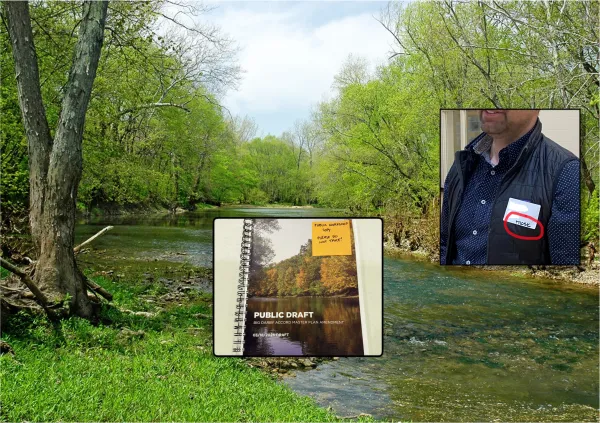
MKSK reps (pictured above) were telling two-dozen or so attendees that reworking the Accord is needed to “further protect the Big Darby” and because “Columbus is one of the nation’s fastest growing communities.”
Also in attendance was one of Columbus government’s most critical planners regarding development, that being deputy director Bryan Clark, who falls staunchly in line with Ginther and City Council.
And it was Clark who recently forced one of the Big Darby’s longest tenured citizen advocates off the Big Darby Accord Advisory Panel. This has always been the gameplan for Ginther and his allies – if you disagree with what their developer friends are demanding, you will be ousted.
“I used to be on the Darby Accord panel, which is the review panel that looked at every development that came forward, but Columbus relieved me of my duties,” said John Tetzloff, who attended the open house and spoke with a Free Press reporter. “I was on the panel for 20 years. This is their event [MKSK] but they’re a front for Columbus. Columbus is driving this plan.”
Tetzloff is also president of the Darby Creek Association which was formed in 1972 and one of the oldest river advocacy groups in the country. His opposition to the single-family Sugar Farms subdivision built within the watershed two years ago put him on Clark and Ginther’s radar.
“The whole Sugar Farms property was supposed to be a demonstration site,” he said, “where they were going to build a state-of-art environmental project that would be a demonstration site for all the other development in the watershed. And Columbus abandoned that idea and put in a pretty standard, high-density development, with nothing special about it.”
It’s bad enough Ginther, City Council and their developer pals are forcing greater density on the community in neighborhoods such as Old North Columbus.
“Columbus likes to tout ‘build up, not out’,” says Tetzloff. “But they are not keeping that strategy here. And in the Darby watershed of all places. It just doesn’t make sense. It’s beautiful. It’s almost a one-of-a-kind stream. It’s a National Scenic River. It’s one of The Nature Conservancy’s last great places. It has 30-plus rare and endangered species.”
Tetzloff and others are asking for a pause to the Accord amendment process so the Ohio Department of Natural Resources (ODNR) can complete an ongoing conservation study of the Big Darby Watershed.
“ODNR’s goal is to share the data it gathers and provide guidance to central Ohio communities with the goal of preventing habitat declines and protecting this exceptional river system,” states their website.
Tetzloff believes Ginther and City Council are determined to pass the Big Darby Accord Master Plan Amendment before the ODNR completes the study.
“They don’t want to run it through the test because they are afraid it will show that the amount of development they want to do won't be protective of the Big Darby,” he said.
“The major issue is that unlike the first accord, established in 2006, they are not willing to test it scientifically. For the first accord, they came up with a plan, and they ran it through an environmental model to see if it would reach its goals. You make a plan, you test the plan. This time, they are not going to test it.”
The ODNR is applying a unique tool and strategy to its Big Darby conservation study. Called Integrated Prioritization System or “IPS,” it organizes and analyzes decades worth of water samples to help understand patterns in stream health. It can explain current conditions and predict what to expect as conditions change.
“There are tools available,” says Tetzloff, “where you can plug in the land-use changes that you are wanting to make. Plug in factors of pollutants that come off a new development. And you put all that into a giant AI tool type tool and it can tell you this is what you can expect the impact will be on the stream. Either all species will be fine, or you are going to start losing mussels, you are going to start losing this species and that species.”
The first phase of the ODNR study utilizing IPS was completed in January. The second phase’s completion is expected later this year. The first phase discovered that mussels are dying off in Hellbranch Run, Big Darby’s second largest tributary, or have died off altogether. No living or freshly dead mussels were found by the ODNR. Freshwater mussels are vital to aquatic ecosystems as they can filter up to 15 gallons of water a day per mussel.
“Caused by years of neglect and overdevelopment,” says Tetzloff on why they have vanished from Hellbranch.
Also trying to weasel into the Big Dary Watershed is Karis Critical, the same developers behind the massive data center project in New Albany. In 2024 they purchased 100-acres of farmland within the Accord boundaries. Here’s a Change.org petition drive to stop them.
“The problem is with the data center it’s a lot of impervious surfaces and a giant building. A lot of concrete, a lot of asphalt,” said Tetzloff. “The original Accord never envisioned a thing such as a data center.”
Much of Tetzloff’s adult life – his purpose – has been championing the health and conservation of the Big Darby Watershed. “They’re saying they are going to stop once they get to a certain point (from the Big Darby). That will be it. But they said that for the first accord, and here we are back to expand development. I think if they would go to their citizens and poll this issue, it would be slaughtered. There’s no way people would vote for this particular plan.”
Councilmember Nancy Day-Achauer will be hosting a public hearing to review proposed changes to the Big Darby Accord. The hearing will take place on Tuesday, April 7 at 5pm in Council Chambers at City Hall.